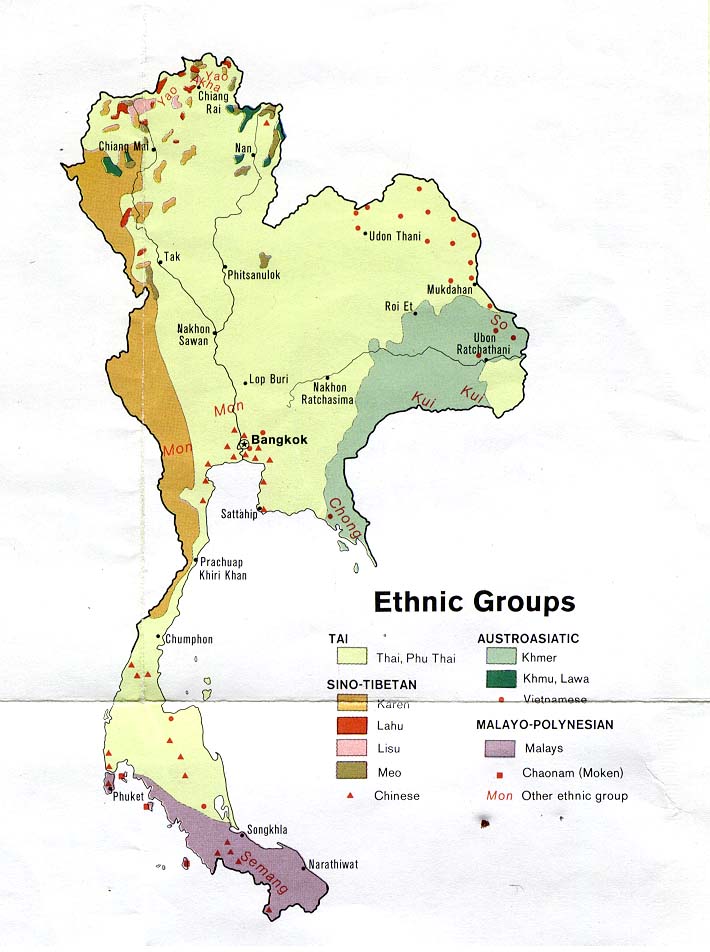
The name bueng means "big" or "great"— therefore they consider themselves the Great Tai, but they are not to be confused with the Tai Yay (Shan) people of northern Thailand and Myanmar, whose name carries the same meaning. The Tai Bueng are probably descendants of the Lao people. They speak a variant of Central Thai marked by tonal shifts, short, tremulous inflections mixed with Lao vocabulary, often ending sentences with "Bueng" or "Der." Most live in the provinces of Buriram, Phetchabun, Nakhon Ratchasima, Chaiyaphum, Saraburi, and Lopburi.
According to oral tradition among Tai Bueng elders, their ancestors migrated from northeastern Laos to Thailand more than 200 years ago. Some believe they are descendants of Lao captives taken from Vientiane by King Taksin of the Thonburi Kingdom in the 18th century. Others suggest they were prisoners of war relocated to central and northeastern Thailand after King Rama III's campaigns in Laos.
Traditional attire for Tai Bueng women includes a short, shoulder-baring vest with a cloth draped diagonally across the shoulder, paired with either chong kraben trousers resembling lantern trousers or a tube skirt. Elders often style their bangs swept back into a small lotus-shaped crest.
Unlike many small tribal groups who have largely been assimilated to Thai culture, the Tai Beung women still wear their distinctive clothes—a traditional chong kaben dress with a heavy silver belt around the waist.
Tai Beung men are keen fishermen. They live near the Pa Sak River, which has an abundant supply of fish. The Tai Beung use homemade wooden boats to go fishing and also construct traps of thinly sliced bamboo. The Thai government has constructed a dam on the river, with the result that half of the people in Ban Manao Hwan had to relocate to avoid the raised water line. Besides rice, they also grow sugar cane and corn as cash crops. They also grow cotton, vegetables and fruits.
The Tai Bueng hold deep beliefs in the mystical powers of nature. They commonly rely on magic, amulets, prayer beads, divination, and fortune-telling to avert misfortune and seek blessing. They also believe spirits can influence health and daily life. During major Buddhist festivals, they make merit and offer alms to monks. When illnesses prove difficult to treat, they may invite ritual specialists to perform camphor divination rituals.
Tai Bueng men observe a Buddhist ordination rite. Candidates must be at least 20 years old and physically whole in all 32 bodily organs. Ordination typically takes place before marriage on an auspicious date. Candidates must practice fluent chanting, and their parents ceremonially present them to the temple with trays of flowers and incense, where they enter monastic training for one month.
Christianity has not made any impact among the Tai Bueng. They remain an unreached and unevangelized group.
May they discover that God's word is a lamp to their feet and a light to their path.
As they rely on amulets to protect themselves and their families, may God reveal to them that he alone is their only protector.
Pray for the Lord to intervene in their families, calling many to his side.
Pray for loving and dedicated gospel workers.
Pray for a church planting movement to thrive in their communities.
Scripture Prayers for the Tai Bueng in Thailand.
Peoples of the Buddhist World, Asia Harvest, Copyrighted © Used with permission
Mission Pathway newsletter, March 2026.
| Profile Source: Joshua Project |